

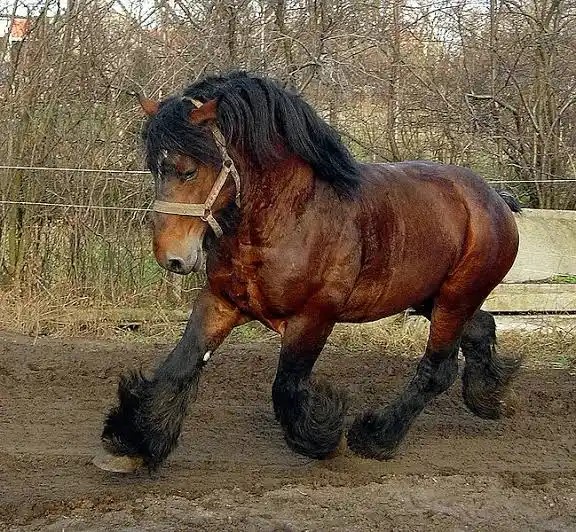
The Belgian Heavy Draft is one of the finest and historically most important heavy horses, and one of the oldest breeds in the world, closely related to the Ardennes.
In the middle Ages, the ancestors of this breed were called "great horses." They carried heavily armed knights into battle. Similar horses are known to have existed in this part of Europe as early as the time of Caesar. Stallions from Belgium were imported to many European countries to produce heavy horses for industrial and agricultural purposes.
The Belgian government played a significant role in the development of this breed. A large National Show was held in Brussels, where this breed was showcased. The prizes were truly enormous. Furthermore, special committees were established to monitor the purity of the breed.
As a result, this breed was declared a national heritage, or even a national treasure. For example, in 1891, Belgium exported stallions to the state stables of Russia, Italy, Germany, France, and the Austro-Hungarian Empire.
The Flanders horse, as it was known in the Middle Ages, influenced the development of several subsequent heavy draft breeds, including the Shire, Suffolk, and especially the Clydelsdale. Today, the Belgian Heavy Draft is also known as the Brabant horse, after its eponymous breeding area in central Belgium.
At the end of the 19th century, there were three types of Brabant horses, each descended from three different lines. The first line of predominantly bay horses—Gros de la Dendre—was founded by the stallion Orange I; the second line—Gris du Hainaut—was founded by the stallion Bayard and consisted of predominantly light and golden-chestnut horses; and the third line—Colosses de la Mehaigne—was descended from the bay stallion Jean I. Today, all descendants of these three lines are united under the name Belgian Coldblood or Brabant horse.
The high mechanization of agricultural labor has somewhat reduced the demand for this giant, known for its gentle nature and eagerness to work. The Belgian Heavy Draft is in demand in several regions of Belgium and in North America.
Over the course of centuries, horse breeders have succeeded in achieving perfection in breeding this breed through strict selection and crossbreeding within one breed. The result is a horse with a short neck, strong shoulder, short legs, deep body, and powerful croup, combined with a gentle nature, making it an ideal heavy horse for field work. The sight of these magnificent horses harnessed to a cart and loaded with water barrels is a wonderful sight.
The Belgian Heavy Draft Horse stands 162–173 cm tall. Its coloring is predominantly chestnut or golden chestnut with black markings. Bay and white horses can also be found. Body structure: small, simple head with intelligent eyes; short, muscular neck; massive shoulder; short, deep, compact body; muscular, strong croup; short, strong legs; hard, medium-sized hooves.
Kakabaeva Zibagozel
Researcher chemical-toxicological
subdepartment veterinary labaratory
department of Scientific and Production
Center for Horse Breeding
Source: EGIDA.BY, a charity portal for animal protection and rights.
© 2006-2025. www.egida.by