

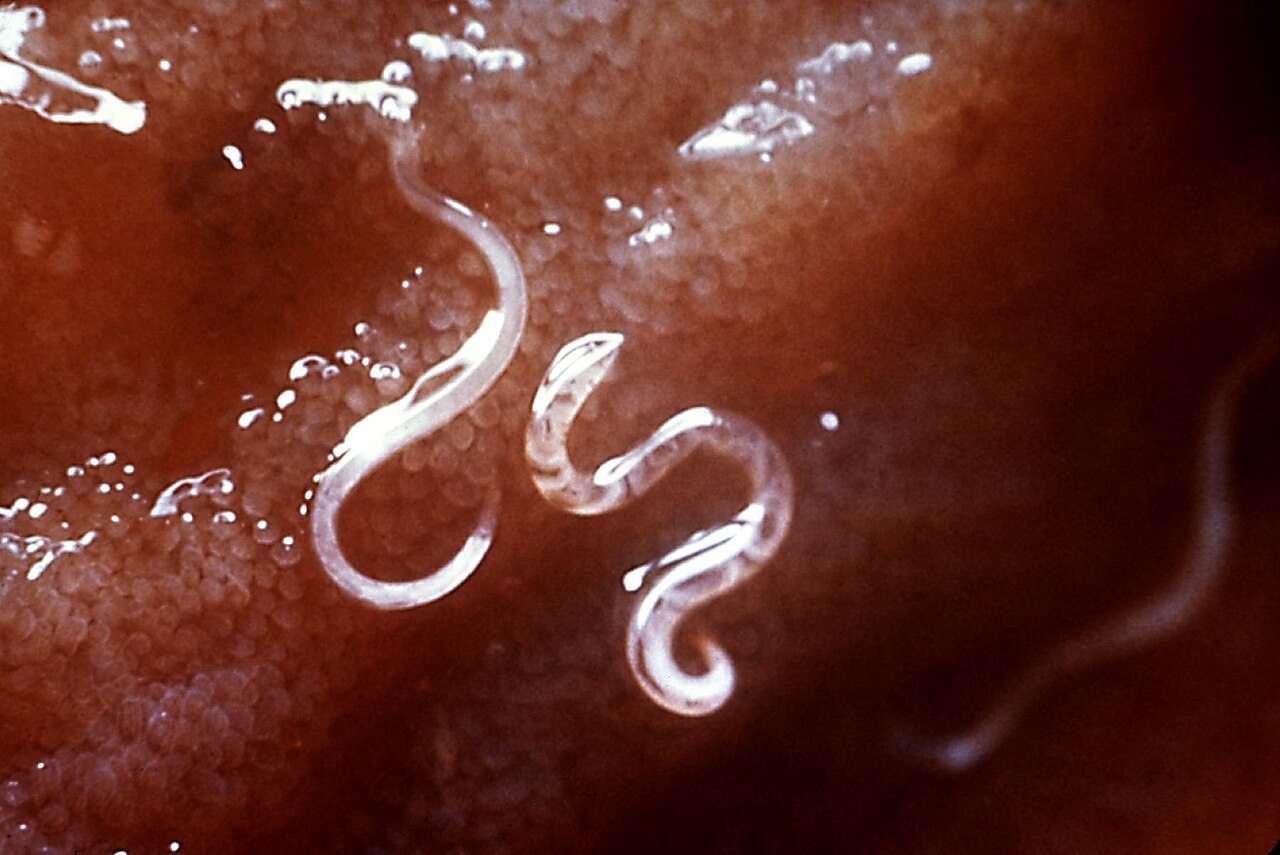
Parasitic diseases are widespread among single-hoofed animals such as horses, donkeys and hinnies. Failure to maintain cleanliness and hygiene rules in stables, stalls and walking areas for horses contributes to the emergence of parasitic diseases. Thus, suckling foals mainly become infected by licking dirty walls or dried manure. The spread of parasitic helminths can be considered using the example of the spread of strongyllates. Parasitic helminths strongyllates – geohelminths.
The spread of strongyllate helminths is associated with the soil, that is, due to the fact that these parasitic helminths do not have an intermediate host, they reproduce by releasing eggs into the external environment. Under favorable conditions, eggs of parasitic helminths that have entered the soil become invasive (capable of infection) within 15-30 days. Thus, within a few days, pathogenic larvae develop in the eggs of parasitic helminths. The probability of invasive helminth eggs entering the gastrointestinal tract of horses through ingested feed, grass and water is very high. Larvae emerge from the eggs in the gastrointestinal tract. Symptoms of diseases caused by parasitic helminths appear on the 3rd – 4th day. The main symptoms of these diseases are indigestion, shortness of breath, difficulty breathing in horses and loss of appetite. Infection of horses with parasitic helminths is accompanied by a decrease in the amount of hemoglobin, red blood cells, eosinophils and other white blood cells, which ultimately leads to exhaustion and deterioration of their condition.
Diagnosis of diseases caused by parasitic helminths:
Determination of the type, distribution (epizootic), as well as the characteristics of various parasitic helminths are carried out on the basis of analyzes in helminthological and serological departments of veterinary laboratories. These analyzes are carried out by various methods (Skryabin, Berman-Orlov and others), which makes it possible to determine and calculate the number of eggs in blood and manure samples of horses.
Pathological damage caused by parasitic helminths to the internal organs of horses:
Penetrating into the mucous layers of internal organs, blood vessels and other cavities, parasitic helminths cause harm to the respiratory organs, liver, heart and gastrointestinal tract. Parasitic larvae that enter the respiratory system of horses lead to irritation and coughing. As a result, sputum is released from the respiratory organs and with it the larvae again enter their oral cavity. Larvae that enter the stomach and intestines of horses reach sexual maturity within 44-77 days. Biological characteristics, distribution and reproduction of parasitic helminths depend on their species. For example, the development and reproduction of parasitic helminths oxyura takes place in the cavity of the large intestine. These helminths are heterosexual - divided into males and females. In order to lay invasive eggs, sexually mature females of oxyura reach from the cavity of the rectum to the mucous membrane of the anus. There they, pulling out the front end, lay eggs on the mucous membrane around the anus. The eggs laid, after some time, dry out and fall on the horse's bedding or the environment. Very often, eggs laid on the mucous membrane cause irritation in horses in the tail area. In such cases, horses worried about itching scratch themselves against the walls of their stalls, facilitating the spread of invasive helminth eggs. Thus, helminth eggs in stalls spread to the surface of lying manure, water and feed, and then again enter the gastrointestinal tract of horses, where they continue their development cycle.
Eggs of parasitic helminths are often found on the walls of stables, garbage dishes, brooms and feeders. Being resistant to the environment, they remain viable even under snow. On cool-weather pastures, eggs can remain invasive throughout the year. However, with an increase in ambient temperature, they lose their invasiveness and dry out and die on average within 61-55 days. The development of nematode larvae in the egg depends on the humidity and temperature of the environment: for example, at an ambient temperature of 15˚C, they develop in 37 days, at 25˚C in 8 days, and at 35˚C in 4 days. Eggs with developed larvae are called “infective eggs.” Diseases that are associated with parasitic helminths occur seasonally and in a certain pattern, but the spread of different helminths does not occur in the same way. For example, the prevalence of parascariasis in foals in Turkmenistan increases in the autumn months and continues until the spring months of the following year.
Measures to prevent diseases caused by parasitic helminths:
Veterinarians must pay due attention to antiparasitic drugs, their pharmacological properties, dosage and quality. It is necessary to require timely cleaning of stable premises, collection of manure in stalls and stables, as well as its disposal in special concrete pits. In pasture areas intended for horses, especially in spring and summer, it is necessary to carry out arable work in order to mix invasive manure with the soil. Scientists and specialists from the scientific and production center for horse breeding recommend carefully studying the epizootic situation of private horse breeding farms and complexes in Turkmenistan, and also paying special attention to improving the quality of preventive measures against parasitic helminths.
Rakhman ABAEV,
scientific secretary
of the Scientific and Production Center
for Horse Breeding